Food Processing & Commercial Kitchen Cleaning Guides
Chilled ready-to-eat and prepared-food manufacturing creates a different cleaning challenge from a normal commercial kitchen. Production may move through raw preparation, cooking, cooling, chilled storage, post-cook handling, portioning and packing, with food-contact equipment used repeatedly across production.
In short: protect food and temperature control, separate raw and post-cook or ready-to-eat activities, make machinery safe, remove food residue, clean with chemistry matched to the soil and surface, rinse where required, verify the cleaning result, sanitise clean food-contact surfaces where required, then restore and release the area according to the site's documented procedure.
This guide is for Victorian manufacturing facilities producing chilled prepared foods for distribution, including cook-chill and pre-prepared meals, chilled pasta and rice dishes, soups, sauces and comparable prepared-food products. It can also assist manufacturers of other refrigerated ready-to-eat foods where the same cleaning principles apply.
Not every chilled prepared food is automatically a ready-to-eat food for regulatory purposes. Whether ready-to-eat requirements apply depends on the product, how it is intended to be consumed and whether it will go through another process that reduces Listeria monocytogenes to a safe level before it is eaten. References in this guide to ready-to-eat requirements apply only where the product falls within the relevant Food Standards Code requirements.
It is not intended for ordinary restaurants or cafes, primary horticulture, or businesses whose regulatory pathway is principally meat, poultry, seafood or dairy processing.
Product directions control. The current label, Product Data Sheet, equipment instructions and site procedure determine dilution, application, contact time, rinsing, surface compatibility and product-use restrictions. Use the current Safety Data Sheet for hazard information, exposure controls, personal protective equipment, first aid, storage, spill response and emergency information. The SDS should not replace the product-use directions.
Why is chilled prepared-food manufacturing different?
A prepared-food factory can contain several hygiene conditions within the same production process.
Raw ingredients may enter one part of the operation, food may then undergo cooking or another controlled process, and the processed product may later be cooled, handled, portioned or packaged.
Food Standards Australia New Zealand requires food to be protected from contamination during processing and says food businesses should use separate equipment or areas for raw and ready-to-eat foods, or clean thoroughly between uses.
Food-contact surfaces must be clean and sanitary. Where a surface is used for both raw food and ready-to-eat food, Safe Food Australia explains that it must be cleaned and sanitised between those uses.
What production zones should be separated in the cleaning program?
A site may use different hygiene-zone terminology. The practical objective is to prevent cleaning equipment, soil or residues from lower-hygiene areas being transferred onto clean food-contact or post-cook equipment.
What is the correct cleaning process for a chilled prepared-food factory?
-
Protect food and prepare the production area.
Remove, relocate or protect exposed food, ingredients and packaging according to the site's procedure. Maintain the required temperature control for chilled food during the clean-down.
-
Make machinery safe before access.
Before reaching into conveyors, mixers, fillers, portioning equipment or other machinery, follow the site's plant-isolation procedure and the equipment manufacturer's instructions.
-
Remove gross food residue.
Remove accessible food, sauces, starch, fats, proteins and other loose material before applying detergent. This reduces the soil load on the cleaning solution.
-
Match the cleaner to the soil and surface.
Routine food oils, heavy fat and protein, mineral scale and low-temperature cool-room soil can require different chemistry. Confirm material compatibility before stronger alkaline, caustic or acidic products are introduced.
-
Clean all required equipment surfaces.
Follow the equipment manufacturer's instructions for access, dismantling and cleaning. Include safely accessible frames, guards, joints, belts, rollers, undersides and transfer points identified in the site's procedure.
-
Rinse where required.
Remove loosened food soil and cleaning solution according to the current product instructions. Do not assume all detergents have the same rinse requirement.
-
Inspect the cleaning result.
Check accessible joints, guards, undersides, belt interfaces, removable components and other areas where food residue can remain. Sanitising should not be used to compensate for ineffective cleaning.
-
Sanitise cleaned food-contact surfaces where required.
Use the site's selected food-area sanitiser or documented combined cleaner-sanitiser process and follow the current concentration, application, contact-time and rinse or no-rinse instructions.
-
Drain, dry or finish as directed.
Complete the finishing step required by the current product, equipment and site procedure before equipment returns to food production.
-
Reassemble, verify and release the area.
Reassemble equipment correctly, complete the site's required verification and records, and resolve any unacceptable cleaning result before production restarts.
How should cleaning effectiveness be verified?
Cleaning verification should be defined by the facility's documented food-safety and cleaning program rather than assumed to be the same for every manufacturer.
Visual inspection is an important practical check before equipment is released back to production. Depending on the site's products, risks and documented program, additional verification methods may also be used.
ATP testing, protein or allergen testing, microbiological testing and environmental sampling should not be represented as universally mandatory methods or frequencies for every chilled prepared-food manufacturer. Where those controls are used, the method, acceptance criteria, frequency and corrective action should come from the site's validated or documented program and any applicable regulatory, customer or certification requirement.
A failed verification result should be resolved according to the site's corrective-action procedure before the affected equipment or area is released for production.
Why is separation between raw and post-cook food important?
Ready-to-eat food may receive no further listericidal process before consumption. Contamination introduced after cooking or another processing control can therefore remain with the product.
FSANZ guidance says businesses should use separate equipment or areas for raw and ready-to-eat foods, or clean thoroughly between uses.
Safe Food Australia further explains that a food-contact surface used for raw food and then ready-to-eat food must be cleaned and sanitised between those uses.
A factory cleaning program should therefore identify the production stage and food-contact status rather than treating all equipment as one generic cleaning task.
How should allergen changeovers be managed?
Where a facility manufactures products with different allergen profiles, its cleaning and production controls should address unintended allergen cross-contact between products.
Changeover controls may include production sequencing, dedicated utensils or equipment where appropriate, dismantling of accessible equipment, effective cleaning and the verification steps required by the site's documented allergen-management and food-safety procedures.
The appropriate cleaning method and verification process depend on the facility, equipment, product and allergen risk. A universal allergen-swabbing method or testing frequency should not be assumed for every food manufacturer.
Where allergen-specific testing or other verification is required by the site's program, customer requirements, certification system or validated procedure, follow those documented requirements.
Allergen labelling and accidental allergen transfer between products are different issues. The Food Standards Code contains mandatory allergen declaration requirements. FSANZ also states that food manufacturers are responsible for managing unintended allergen presence caused by cross-contact. The Code does not set one cleaning, swabbing or verification program for every manufacturer. Each facility should follow the allergen controls in its documented food-safety or allergen-management procedures.
Why does Listeria matter in chilled ready-to-eat production?
The Victorian Department of Health states that Listeria monocytogenes can continue multiplying under refrigeration temperatures.
Refrigerated foods can therefore become contaminated and, under certain conditions, allow the organism to increase while the food remains chilled. Foods that are eaten without further treatment capable of killing the organism require particular care.
The practical cleaning consequence is that refrigeration should not be treated as a substitute for hygiene. Food-contact equipment and surrounding production areas still need effective cleaning, appropriate sanitising and controls that prevent recontamination.
Do not copy the ready-to-eat meat testing program into every prepared-food factory. Safe Food Victoria has separate, prescriptive Listeria-management requirements for regulated ready-to-eat meat businesses. Those meat-sector requirements do not automatically become a mandatory environmental-sampling schedule for an unrelated council-registered prepared-food manufacturer.
For food that meets the Food Standards Code definition of ready-to-eat, Standard 1.6.1 and Schedule 27 contain mandatory microbiological criteria for Listeria monocytogenes. The applicable criterion depends on whether growth of the organism can occur in the particular food.
How should post-cook conveyors, fillers and packing equipment be cleaned?
Post-cook equipment needs attention beyond the easily visible food-contact surface.
Food and cleaning residues can remain around belt edges, joints, rollers, fillers, depositors, frames, guards, tray interfaces and removable components.
Follow the equipment manufacturer's instructions and the site's isolation procedure before accessing guarded or hazardous parts.
Remove food soil first, clean with suitable chemistry, rinse where required, inspect the equipment and then sanitise where the documented procedure requires it.
How should mixers, kettles and prepared-food equipment be cleaned?
Prepared foods can leave combinations of starch, sauces, oils, fats and proteins in the same vessel.
Cleaning chemistry should therefore be selected from the actual soil, surface and equipment instructions rather than from the equipment name alone.
A neutral detergent may be sufficient for routine oily residue. Heavier fat or protein deposits may justify stronger alkaline chemistry on compatible surfaces.
Where equipment is dismantled for cleaning, follow the manufacturer's instructions and include removable food-contact components in the site's cleaning, sanitising and verification procedure.
How should cool rooms and walk-in freezers be cleaned?
Refrigerated production and storage areas can require chemistry formulated to work at low temperatures.
Agar Cold King is a ready-to-use alkaline detergent that Agar specifically documents for hard surfaces in cool rooms and walk-in freezers. Its documented applications include suitable floors, walls, shelving and racking, and Agar states that it can be used at sub-zero temperatures without thawing the freezer for normal cleaning.
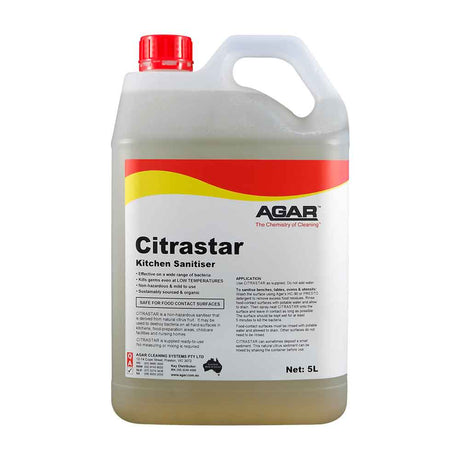
Agar Citrastar is a separate hard-surface sanitiser that Agar documents as effective at low temperatures, including freezers and cool rooms.
Citrastar is not a produce wash and it is not for direct use on food. Agar's current Product Data Sheet also requires food-contact surfaces to be rinsed with potable water after Citrastar is used. Follow the current PDS rather than assuming that a product described as food-grade or food-safe is automatically rinse-free.
How should floors and drains be managed?
Floors and drains can collect organic residue, oils, sauces, water and production debris. They should form part of the site's cleaning program rather than being treated as unrelated housekeeping.
Remove accessible solids first and use chemistry matched to the remaining soil and floor finish.
Keep floor and drain-cleaning equipment controlled so it does not transfer soil onto food-contact equipment or cleaner post-cook areas.
Recurring standing water, damaged surfaces or poor drainage should not be treated solely by increasing chemical strength. Premises and equipment need to be maintained so effective cleaning can be carried out and contamination risks can be controlled.
How should temperature control be protected during cleaning?
Cleaning should be planned so chilled food is not unnecessarily left outside controlled storage.
Safe Food Victoria's current guidance states that cold food should be kept at 5°C or colder. Where a business uses another time-temperature control permitted by the Food Standards Code, that control should be supported by the business's documented food-safety process.
Before cleaning a cool room, line, filler or chilled production area, relocate or protect food according to the site's food safety program and documented production procedure.
Which cleaning chemicals fit prepared-food manufacturing?
Product selection should start with the soil, surface, cleaning method and required hygiene outcome. Janitorial Depot supplies and sources commercial cleaning chemistry for food-processing businesses; the examples below are product-selection options, not an onsite cleaning service.
| Cleaning problem | Product examples — check suitability and availability | Main selection point |
|---|---|---|
| Routine oils and general production soil | Whiteley Tempo HD | pH-neutral, solvent-free detergent documented by Whiteley for emulsifying common food oils and other oily residues. Useful where strong alkalinity is unnecessary. |
| Heavier general grease | Agar Speed | Stronger general hard-surface degreasing for compatible floors, walls, machinery and other washable surfaces. |
| Heavy fat, grease and protein | Agar Active Break | Highly alkaline food-processing cleaner for heavy fat, grease and protein on compatible surfaces. Agar identifies a specific aluminium restriction, so the current PDS must be checked before use. |
| Foaming food-processing cleaning and sanitising | Agar Foam Up | Food-grade foaming cleaner-sanitiser documented for fats, proteins and oils on compatible food-processing equipment and surfaces. |
| Combined cleaning and sanitising | Agar Single Step, Agar HygieniCLEAN | Combined cleaner-sanitiser chemistry for documented applications. Dilution, rinsing and food-contact finishing requirements vary by product and application. |
| Low-temperature cool rooms and freezers | Agar Cold King | Ready-to-use low-temperature detergent specifically documented for hard surfaces in cool rooms and walk-in freezers. |
| Mineral scale | Agar Scale Force | Acidic descaler for compatible stainless-steel and other documented food-processing equipment. Agar excludes aluminium, brass, copper, zinc and galvanised iron. |
| Separate sanitising after cleaning | Agar Powerquat , Agar RF-12 , Agar Ready 2 Go | Food-processing sanitisers for already cleaned surfaces. Concentration, contact time and rinse or no-rinse requirements are product-specific and must come from the current PDS and site procedure. |
| Low-temperature hard-surface sanitising | Agar Citrastar | Agar documents Citrastar for hard-surface sanitising at low temperatures. It is not for direct food use and its current PDS requires potable-water rinsing of food-contact surfaces after use. |
For a broader comparison of cleaning chemistry by soil, surface and application, see the Commercial Kitchen & Food Processing Cleaning Chemicals Guide .
Why should cleaning and sanitising remain separate concepts?
FSANZ distinguishes cleaning from sanitising.
Cleaning removes food waste, grease, dirt and other soil. Sanitising is performed on a clean surface to reduce microorganisms.
Some products are specifically formulated as cleaner-sanitisers and can perform both functions when used according to their current directions. That does not mean every sanitiser is also an effective degreaser or every detergent performs a sanitising function.
What are the Victorian regulatory requirements for these manufacturers?
For the prepared-food manufacturers covered by this article, the starting regulator is generally the local council.
Safe Food Victoria's current regulator directory specifically lists manufacturers of ready meals, pre-prepared meals, soups and sauces under local council.
| Requirement | Victorian position |
|---|---|
| Registration | Prepared-food manufacturers covered by this article generally register with their local council. The council determines the classification of the premises. |
| Classification | Safe Food Victoria lists cook-chill short or extended shelf-life manufacturing, including pre-prepared meals, pasta, rice, soups and sauces, as Class 2 examples. The registering council still makes the actual classification decision based on the food activities at the premises. |
| Food safety program | FoodSmart cannot be used by food manufacturers. Current Safe Food Victoria guidance says manufacturers must develop a non-standard food safety program to meet their specific requirements. |
| Food-safety audit | Under the current Victorian Food Act declaration, the default for a Class 2 premises using a non-standard food safety program is one food-safety audit annually within the registration period. The registration authority can apply another permitted frequency based on food-safety performance, but the declaration still requires at least one audit for a Class 2 premises using a non-standard program within the registration period. |
| Food safety supervisor | Class 2 premises are required to have a food safety supervisor unless an applicable exemption under the Victorian declaration applies. |
| Food Standards Code | Standards 3.2.2 and 3.2.3 contain core food-handling, cleaning, sanitising, premises and equipment requirements relevant to these manufacturers. The Australia New Zealand Food Standards Code is enforced in Victoria through the Food Act framework. |
Standard 3.2.2A should not simply be copied from a restaurant or catering checklist into a manufacturing facility. FSANZ describes Standard 3.2.2A as applying to specified food-service, catering and related retail businesses. Food manufacturers remain subject to the applicable manufacturing, Food Act and Food Standards Code requirements, including Standards 3.2.2 and 3.2.3.
Is PrimeSafe still the regulator?
No. PrimeSafe is now a historical regulator.
Safe Food Victoria commenced operation on 1 July 2026. The new authority took over the relevant Victorian meat, poultry, seafood and dairy regulatory functions previously split across specialist agencies, including PrimeSafe and Dairy Food Safety Victoria, together with relevant food-regulatory functions transferred into the new authority.
Safe Food Victoria now licenses meat, poultry, seafood and dairy businesses. Local councils remain responsible for registering and regulating most other Victorian food-service, retail and manufacturing businesses.
That boundary matters here. A prepared-meal manufacturer can fall under local-council registration, while a further meat-processing facility where the majority of products manufactured are meat, poultry or seafood follows the Safe Food Victoria licensing pathway.
Businesses near that regulatory boundary should confirm their regulator rather than assuming one pathway applies.
Meat-processing, butcher and smallgoods requirements are covered separately in the Meat Processing, Butcher & Smallgoods Cleaning Guide .
How should hazardous cleaning chemicals be managed?
Food-processing chemistry can include strongly alkaline, caustic or acidic products.
WorkSafe Victoria identifies caustic cleaners as hazardous substances that can cause serious skin and eye injuries. Employers must eliminate or reduce risks associated with hazardous substances so far as reasonably practicable.
WorkSafe also requires employers using or storing relevant hazardous substances or dangerous goods to obtain current Safety Data Sheets and make them accessible to employees, contractors and emergency-services personnel.
Janitorial Depot maintains a separate Safety Data Sheets (SDS) Library to support customers looking for current product safety information.
SDS and product-use information have different jobs. Use the SDS for workplace hazards, handling, exposure controls, PPE, storage, spills, first aid and emergency information. Use the current product label, PDS and manufacturer technical instructions for product selection, dilution, application, contact time, rinsing and surface-use restrictions.
What should be included in the cleaning schedule?
A prepared-food factory cleaning schedule should identify the actual production area, equipment, soil, chemistry and hygiene stage rather than simply listing “factory clean” as one task.
| Schedule field | What to record |
|---|---|
| Area or equipment | Mixer, cooker, conveyor, filler, tray sealer, bench, rack, cool room, floor, drain or other exact zone. |
| Production stage | Raw preparation, cooking, cooling, post-cook handling, packing or chilled storage. |
| Food-contact status | Whether the surface directly contacts food. |
| Expected soil | Oil, fat, protein, starch, sauce, scale or other food residue. |
| Cleaning product | Exact cleaner selected for the task. |
| Dilution | Current manufacturer or documented site working dilution where applicable. |
| Cleaning method | Wipe, scrub, mop, foam, soak or equipment-specific method. |
| Rinse requirement | Current product and site finishing requirement. |
| Sanitiser | Separate sanitiser or documented cleaner-sanitiser where required. |
| Contact time | Current manufacturer requirement where applicable. |
| Frequency | Frequency determined by the site's production, food-safety program and risk controls. |
| Responsible role | Person or role responsible for completing the task. |
| Verification | Visual inspection, test or other verification required by the site's documented program. |
| Corrective action | Action required when cleaning or verification is unacceptable. |
Common cleaning mistakes in chilled prepared-food manufacturing
- Treating refrigeration as if it removes the need for effective cleaning and sanitising.
- Moving cleaning tools from raw production into post-cook or ready-to-eat areas without suitable controls.
- Sanitising equipment that still contains visible food residue or grease.
- Cleaning only visible conveyor or filler surfaces while leaving residue around frames, joints, rollers, guards and undersides.
- Selecting the strongest alkaline product for every task instead of matching chemistry to the soil, surface and equipment.
- Using ordinary cleaning chemistry in a sub-zero environment without checking whether the product is suitable for low-temperature use.
- Assuming every food-area sanitiser is rinse-free.
- Assuming a product described as food-safe or food-grade can be applied directly to food.
- Allowing chilled food to remain unnecessarily outside required temperature control during cleaning.
- Treating persistent drainage or standing-water problems as something that can be solved only with stronger chemicals.
- Accessing conveyors, fillers, mixers or other machinery for cleaning without applying the site's required isolation procedure.
- Applying ready-to-eat meat testing requirements to an unrelated council-registered prepared-food manufacturer without confirming that those requirements apply.
- Assuming ATP, allergen swabbing or environmental microbiological sampling has one mandatory frequency for every manufacturer.
- Treating an SDS as the cleaning instruction rather than also checking the current label and Product Data Sheet.
Chilled ready-to-eat and prepared-food cleaning FAQs
Who regulates ready-meal manufacturers in Victoria?
Safe Food Victoria's current regulator directory lists manufacturers of ready meals, pre-prepared meals, soups and sauces under local council. The registering council determines the premises classification.
Are Victorian cook-chill food manufacturers Class 2?
Safe Food Victoria lists cook-chill short and extended shelf-life manufacturing, including pre-prepared meals, pasta, rice, soups and sauces, as Class 2 examples. The local council makes the actual classification decision based on the activities at the premises.
Is every chilled prepared food legally ready-to-eat?
No. The Food Standards Code definition depends on how the food is ordinarily consumed and whether it will undergo a listericidal process before consumption. A chilled product should not be treated as legally ready-to-eat merely because it is refrigerated or pre-prepared.
Can a food manufacturer use the FoodSmart template?
No. Current Safe Food Victoria guidance states that FoodSmart does not apply to food manufacturers. Manufacturers must develop a non-standard food safety program appropriate to their specific requirements.
Does a Class 2 manufacturer using a non-standard food safety program need an audit?
Yes. The current Victorian declaration sets the default at one food-safety audit annually within the registration period for a Class 2 premises using a non-standard food safety program. The registration authority may apply another permitted audit frequency based on food-safety performance, but at least one audit remains required within the registration period under the declared range.
Can Listeria grow at refrigeration temperature?
Yes. The Victorian Department of Health states that Listeria can continue multiplying under refrigeration temperatures. Effective cleaning, sanitising where required and contamination controls remain important in chilled ready-to-eat production.
Does every prepared-food factory need the Safe Food Victoria ready-to-eat meat Listeria testing program?
No. Safe Food Victoria has specific requirements for regulated ready-to-eat meat processing. Those requirements should not be represented as a universal environmental-testing program for every council-registered prepared-food manufacturer.
Is ATP testing mandatory for every chilled food manufacturer?
No universal ATP-testing requirement or frequency should be assumed. FSANZ recognises visual inspection, ATP testing, protein swabs, microbiological testing and environmental monitoring as possible verification approaches in food processing. The method and frequency used at a particular facility should come from its documented food-safety, hygiene, customer or certification requirements.
What cleaner can be used in a walk-in freezer?
Use chemistry documented for the actual operating temperature. Agar Cold King is specifically formulated for hard-surface cleaning in cool rooms and walk-in freezers and is supplied ready to use.
Should equipment be cleaned before it is sanitised?
Yes. FSANZ distinguishes cleaning from sanitising and states that items need to be cleaned before they are sanitised. Some documented cleaner-sanitiser products can perform both functions in one process where their current directions support the application.
Is PrimeSafe still the Victorian meat regulator?
No. Safe Food Victoria commenced on 1 July 2026 and now performs the relevant Victorian meat, poultry, seafood and dairy regulatory functions previously split across specialist regulators including PrimeSafe and Dairy Food Safety Victoria.
Continue with the food-processing cleaning guides
- Food Factory Cleaning Guide: Process, Chemicals & Sanitising
- Commercial Kitchen & Food Processing Cleaning Chemicals: What to Use & Where
- Bakery & Pie Factory Cleaning Guide
- Meat Processing, Butcher & Smallgoods Cleaning Guide
- Food Processing Cleaning & Sanitising Resource Library
Need help matching food-processing cleaning chemistry?
Janitorial Depot supplies commercial cleaning chemicals and related janitorial products for food-processing businesses. Contact the team for product matching, specialist Agar or Whiteley products, bulk quantities, recurring commercial supply and product documentation.
View Commercial Cleaning ChemicalsReviewed against current Victorian and FSANZ guidance: 14 September 2026.
Sources and technical references
- Safe Food Victoria — Who should I be registered with?
- Safe Food Victoria — Classifications for food businesses
- Safe Food Victoria — FoodSmart food safety program
- Safe Food Victoria — Food service, retail and manufacturing
- Safe Food Victoria — Safe food preparation, storage and display
- Safe Food Victoria — Cleaning and sanitising for food businesses
- Safe Food Victoria — About Safe Food Victoria and Victorian food safety legislation
- Safe Food Victoria — Listeria management of ready-to-eat meat technical guideline — used here only to distinguish the separately regulated ready-to-eat meat sector from general prepared-food manufacturing.
- Victorian Department of Health — Listeriosis
- Food Standards Australia New Zealand — Processing food safely
- Food Standards Australia New Zealand — Cleaning and sanitising
- Food Standards Australia New Zealand — Food Safety Standards
- Food Standards Australia New Zealand — Limits for Listeria monocytogenes in ready-to-eat foods
- Food Standards Australia New Zealand — Standard 3.2.2A food safety management tools
- Food Standards Australia New Zealand — Allergy information for food manufacturers, retailers and importers
- Food Standards Australia New Zealand — Compendium of Microbiological Criteria for Food
- Victoria Government Gazette — Food Act 1984 declaration of food-premises classes, food safety programs, supervisors, audits and assessments
- WorkSafe Victoria — Isolate, de-energise, lockout and tagout plant
- WorkSafe Victoria — Using caustic cleaners
- WorkSafe Victoria — Safety Data Sheets
- Agar Cleaning Systems — Cold King, Active Break, Foam Up, Single Step, HygieniCLEAN, Scale Force, Powerquat, RF-12, Ready-2-Go and Citrastar.
- Whiteley — Tempo HD
Safety Data Sheets provide workplace hazard, handling and emergency information. Product selection, dilution, application, contact time, rinsing and surface-use directions should be confirmed from the current product label, Product Data Sheet or other current manufacturer technical documentation as applicable.